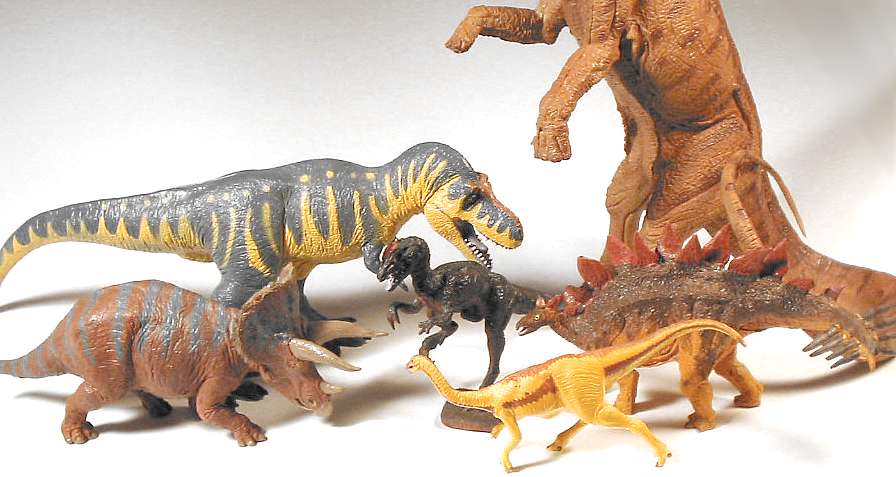
Battat First Series (1994) 1:40 dinos

• new dinosaurs for 1994 •
Dilophosaurus wetherilli
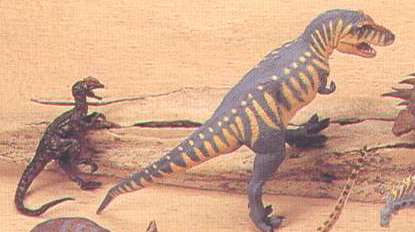
This 1994 Dilophosaurus is probably the Battat figure with the biggest stability problems. He was supposed to be standing in a nice dynamic pose, on one foot. But even the product photographer for Battat couldn't get him to do it - a log had to be used as a crutch.
I don't have one. The photo is of the 1996 "snowshoe" version, which stands just fine.
|
|
|
|
Even Battat and the Museum of Science couldn't get this guy to stand by his lonesome. Here's an old advertising picture with Dilophosaurus and Tyrannosaurus leaning on a handy log.
|
|
Diplodocus longus
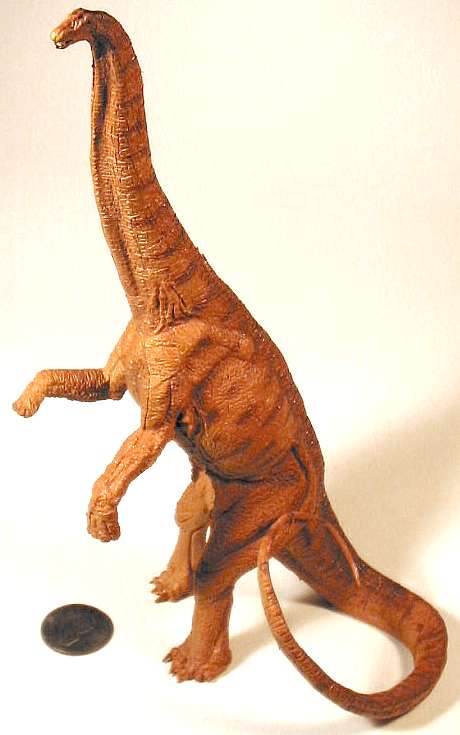
This is by far the biggest and most imposing (and most expensive) figure in the Battat set. The pose is controversial but not outlandish. Charles Knight depicted Diplodocus that way ages ago.
This figure was basically made in an ordinary three-segment mold - left, right, and ventral/medial surfaces of legs. But it looks like most of the tail was glued on in a secondary manufacturing step. Battat hit on just the right consistancy of vinyl for this figure - not so hard that the neck or tail are in danger of snapping off, but not so soft that the feet get out of shape.
|
Markings -
This figure has no markings at all - no copyright notice, no "made in China," no CE mark, nada.
|

|
|

|
Two thirds of the tail is a separate molding, glued on. The joint is visible just below three o'clock in the photo at left.
|
|
Gallimus bullatus
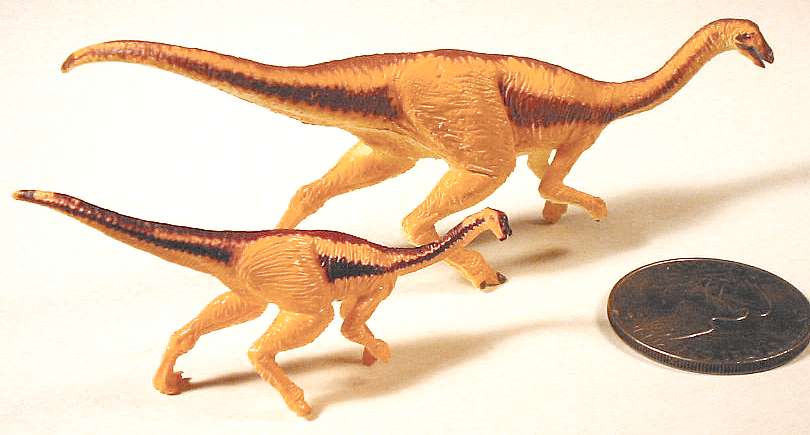
Another well-done though relatively conventional figure. Stability on three feet is good. It was made in a three-segment mold, nothing radical there. The small figure is from Battat's 1988 Mini Dinosaur Collection and so, strictly speaking, doesn't belong on this page of 1994 1:40 figures .... but so what.
|
Markings -
© 1994 MUSEUM OF SCIENCE BOSTON
GALLIMIUS BULLATUS (19 FEET LONG)
BATTAT INC
CHINA
|

|
|
Stegosaurus armatus
This is an unusual figure, as the sculptors had the temerity to arrange the tail spikes unconventionally. I like the horizontal layout, although eight spikes seems excessive. When Marsh reconstructed S. ungulatus (now considered to most likely be the same thing as S. armatus, making the name S. ungulatus obsolete) in 1879, he drew it with four pairs of spikes on the tail. In 1903, Charles R. Knight sculpted a model conforming very closely with our modern notions of Stegosaurus, and for the first time Stegosaurus was shown with two pairs of spikes. Lesser artists afterwards tended to revert to four - or, in a weird 1905 effort, five - pairs of spikes. In 1928, Knight put his customary two pairs on the Stegosaurus he painted for the Field Museum, and in 1941 Zdenek Burian put two pairs on his Stegosaurus, painted as per direction of Dr. Joseph Augusta. And with two pairs of spikes Stegosaurus stayed, until Battat came along to rock the boat.
The Battat S. armatus has seventeen plates, which seems to be characteristic of S. stenops, at least. The holotype of S. armatus, last I heard, had yet to be completely prepared or described. I summarize things here, on the page devoted to the Louis Marx Stegosaurus.
The mold for the Battat Stegosaurus has four segments - left, right, ventral/between the legs, and a fourth segment forming a thin dorsal strip and the medial (inboard) faces of the two rows of plates. This fourth segment extends to the tip of the snout but does not run to the end of the tail - it stops just short of the second plate from the end. The upper surfaces of the tail and spikes are part of the left-side mold segment, and the lower surfaces are part of the right-side segment. This arrangement requires a bit of an undercut on the tail - not too bad, as the vinyl of this figure is relatively soft (improving the durability of the plates and spikes).
|
Markings -
© 1994 MUSEUM OF SCIENCE BOSTON
STEGOSAURUS ARMATUS (25 FEET LONG)
BATTAT INC
MADE IN CHINA
|

|
|

|
Let's have another look at those tail spikes -
|
|
Triceratops horridus
Although nothing radical, this figure was very well done. It was made in a five-segment mold - left, right, ventral/medial side of legs, dorsal neck/posterior surface of frill, and forehead/anterior of frill/medial aspects of horns.
|
Markings -
© 1994 MUSEUM OF SCIENCE BOSTON
TRICERATOPS HORRIDUS (29 FEET LONG)
BATTAT INC
CHINA
|

|
|
Tyrannosaurus rex, first try
The 1994 version was the T. rex which wouldn't stand up. I don't have one. Pictured is the third (1988) version, with the tail bent downward for support. First and third versions are identical except for the tail. This old advertising photo shows the old-type tail.
|
|
|
|