

Although not so imposing an affair as the Marx Brontosaurus, the MPC figure is original. It was made in a 2-piece mold. It's a good figure, the only problem being that it's 'way too small to be even approximately in scale with most of the other MPC figures. Those on the verge of being scandalized by nomenclature should see the writeup on the Marx Brontosaurus about the Brontosaurus vs. Apatasaurus situation before firing off their angry letters to the Times. There's also some information about that inappropriate Camarasaurus-like head poor Brontosaurus wore for so many years. Read it here. Markings - BRONTOSAURUS (left side of tail), 70' LONG (right side of tail), 15 (on inboard side of left rear leg) |
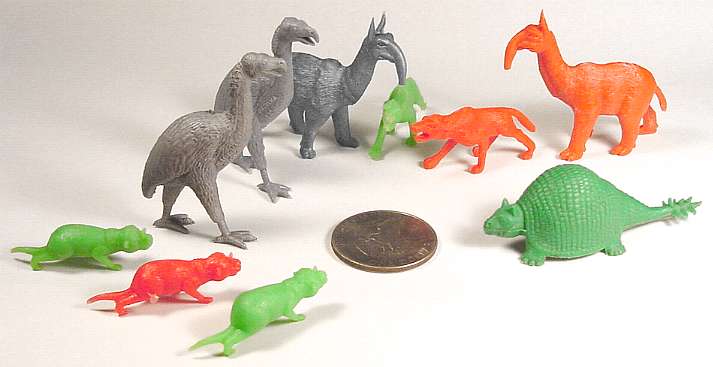
These are pretty decent figures ... too bad MPC didn't make more like them. Alert readers have doubtless already noted that none of these are dinos. We have four representatives of class Mammalia and one of class Aves, but they'll just have to do. Ceratogaulus, a Miocene native, was, oddly enough, a horned rodent. Only my older references mention him. Henry Osborn tells us, in The Age of Mammals (1910), " . . . there has been discovered the extraordinary Ceratogaulus rhinocerus, which has a special horn-bearing bone on the nasals, which was undoubtedly capped with a prominent pointed dermal horn." And Karl von Zittel (Grundzüge der Paläontologie Vol. III, revised 1916, further revised 1925) notes "Ceratogaulus Matthew (with bony horn-core on the nasals)" as a member of the subfamily Mylagaulinae, which have extremities apparently adapted for digging. The most recent mention in my library is in Romer (Vertebrate Paleontology, 3rd edition, 1966) which tells us only that Ceratogaulus is found in the Upper Miocene of North America. The MPC figure was made in a 2-piece mold, and in the usual inappropriate MPC colors. 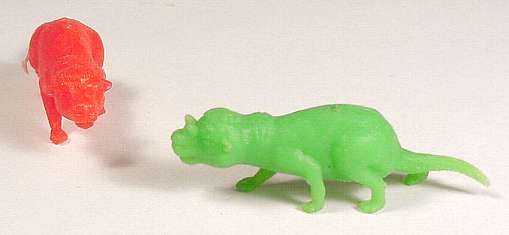
Markings - CERATOGAULUS (left side of tail), 2' LONG (right side of tail) Diatryma was a giant ratite found in Lower Eocene strata of Europe and North America. Aside from the obvious (the heavy-duty legs and the tiny - or nonexistent - wings), the identifying feature of the flightless ratite is a large flat breastbone lacking the prominent keel shape characteristic of flying birds. The ostrich, emu, cassowary, and kiwi are modern living ratites, and the elephant bird of Madagascar and the huge moa of New Zealand, though now extinct, still count as modern. These are/were herbivores, but it's hard to credit the idea that Diatryma's huge beak was meant for crushing berries, and he's one of several large Tertiary birds believed to have been carnivorous, although professional opinion varies (the shapes and internal structures of teeth give a pretty good indication of what an animal is supposed to eat; when an animal has no teeth speculation as to diet can become problematical). Apparently the early Eocene landscape hadn't yet filled up with sizeable mammalian carnivores, and perhaps these imposing birds filled the niche occupied in later eras by the animals we moderns would expect, such as lions and tigers and Ursus spelaeus. 
This is a good-looking figure, although the pose isn't very dynamic. I don't think I'm sticking my neck out too far when I postulate that it was sculpted from Zallinger's Age of Mammals. Here's a detail from the verison published in Life in 1953. This Diatryma also appears in the mural version Zallinger later painted at Yale. 
So far as I can see, Zallinger's vision is wingless. However, it looks like MPC's sculptor has interpreted, incorrectly, all those feathers on the bird's back and tail as folded wings. This figure was made in a 2-piece mold, and it stands well, even though it's only on two feet. That doesn't sound like a big deal, but some manufacturers - even fancy ones, like Battat - have trouble accomplishing it. My only real complaint with this figure is that it doesn't look all that much like any species of Diatryma known to me. The beak should be a big puffin-like crusher and the wings are all wrong. The hooked beak makes the figure look perhaps more like Phororhacos, a Miocene ratite from South America, some six feet tall with a skull about the size of a horse's. But it's hard to say, as the typical illustrations are rarely identified to specific level, and it's never clear how much of a specimen is a conjectural reconstruction (but it's always safe to guess that it's more than one thinks). A laudable procedure at archaeological sites is to make the reconstructed portions easily identifiable (no fake ageing) so it's obvious to all what's known and what's guesswork (albeit educated guesswork). Alas, they don't usually do it that way in paleontology. Markings - DIATRYMA, 7' LONG (both on right side of lower neck) During the mid-Tertiary the Panamanian land bridge submerged, and for some 40 million years North and South America were separated. During this period, neither of the two major living orders of ungulates (hoofed mammals, more or less) which dominated in North America and the Old World, the mesaxonic (odd-toed) perissodactyls (horses, tapirs) and paraxonic (even-toed) artiodactyls (camels, deer), reached South America. The local forms radiated remarkably, with species ranging from rat- to elephant-sized, and occupying the niches in which we normally expect to find hippos, rhinos, or horses. Note that the ungulates are something of a mixed bag, and may not be monophylatic; that is, they may not actually all be closely related in an evolutionary sense. Actually, the group is hard to define; not all even have hooves - so the brief description of ungulates as "hoofed animals" is in some cases misleading. The sirenians (sea cows) are lumped in with the ungulates, as are the hyrax and elephants. Some terrestrial forms retained claws, never developing proper hooves. The systematics are a mess .... but nothing an energetic grad student couldn't make worse.All of these uniquely South American ungulates were extinct by the end of the Pleistocene. The major orders were the Notungulata and the Litopterna. The last of the Litopterna was Macrauchenia, a three-toed hoofed animal of llama-like aspect. Macrauchenia appeared in the Pliocene and became extinct at the end of the Pleistocene. Its skull is peculiar. Despite a long snout, the nasal openings are on top of the skull, nearly as far back as the eyes. Pits in the bones of the forehead may indicate attachment points for well-developed muscles, which may imply a short trunk. The Pleistocene M. patagonica was about the size of a camel. Here are dorsal (in this case, top) and lateral (side) views of the skull of Macrauchenia, from Alfred Sherwood Romer, Vertebrate Paleontology (3rd ed, 1966). Although Romer doesn't give the specific name of the specimen shown, it looks to me to be a M. patagonica. 
The MPC figure is certainly striking. I suspect that the legs are too thick (I would expect them to be more like those of a camel), and the trunk and, especially, the ears, are entirely speculative. Those ears made the figure much more expensive to make. This figure represents a first from MPC - a 4-piece mold (left, right, top of head, and a ventral surface including the insides of the legs). The small mold segment on top of the head is what gives this figure its free-standing ears. It's what MPC and Marx should have done for Smilodon's fangs. Although the legs are a bit flat on the inboard sides - they should have been able to make them fuller with such a complex mold - this is generally a very well-done figure. If MPC had put this sort of effort into their other figures they would have had a premium dino line. 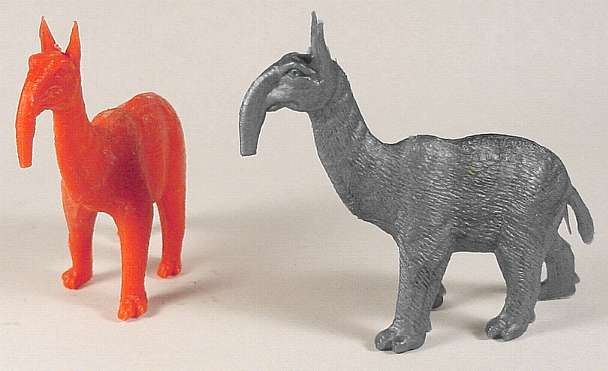
Markings - MACRAUCHENIA, 18' LONG (both on top of back) Like most MPC figures, this was made in a 2-piece mold. The Dire Wolf has a perfectly good Linnaean name, Canis dirus, but MPC opted to not use it. This would be a useful figure for, say, a Rancho La Brea play set, as the tar pits are full of these wolves, although C. dirus looked much like a modern wolf and figures of such could obviously be substituted. The indispensable Charles R. Knight left us a picture in one of his murals at the American Museum of Natural History in New York - 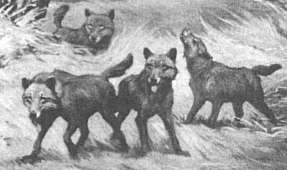
And now, a closeup of the MPC vision (I suspect that Knight's treatment of the ears is more likely than MPC's). The figure I photographed is about the same color as a napalm attack, and it doesn't show shadows and details well on a monitor ... but a conversion to black & white fixed that - 
Markings - DIRE WOLF (left side of tail), 5' LONG (right side of tail) Another figure which should have put MPC into the front ranks of rubber-dino-meisters, solely by virtue of rarity. Starlux made a Glyptodon, and Invicta came out with one circa 1975. So, which is it, Glyptodon or Glyptodont? Glyptodont would be any members of the family Glyptodontidae. There are several genera in the family Glyptodontidae, Glyptodon being one. The MPC figure is surely meant to be the biggest of them, the Pleistocene giant Doedicurus .... in which case, the MPC figure would be a Glyptodont, but not a Glyptodon. It gets complicated. Henry Fairfield Osborne (Age of Mammals, 1910) lists eight genera in family Glyptodontidae, only five of them being "proper" Glyptodons of the subfamily Glyptodontinae. He shows Doedicurus in a separate subfamily, Doedicurinae. Karl von Zittel (Grundzüge der Paläontologie Vol. III, revised 1916, further revised 1925) briefly describes thirteen genera. He shows Doedicurus in a separate family, Doedicuridae. Alfred Romer (Vertebrate Paleontology, 3rd ed, 1966) lists some 43 genera, all in the same family, Glyptodontidae (although he has Doedicurus spelled Daedicurus). Robert Carroll (Vertebrate Paleontology and Evolution, 1988) has the self-control to say only that there are four or five subfamilies of Glyptodontidae. All of which leaves us little the wiser. Here's Charles R. Knight's take on the Glyptodont matter, from one of his murals at the Field Museum of Natural History in Chicago. He seems to have given us both a Doedicurus and a Glyptodon (and Megatherium in a pose of studied indifference). 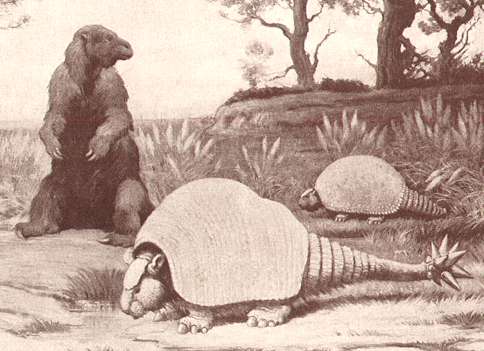
UPDATE - My current theory - that two of the primary visual sources for the Marx and MPC figures were the Zallinger Age of Reptiles mural and the smaller Life version of the Age of Mammals - implies that the MPC glyptodont was patterned after a painting of Boreostracon, rather than Doedicurus. Here is the extreme lower-right of the Age of Mammals, as published in Life in 1953 - 
Now, I am not happy about this. According to Gillette and Ray (Glyptodonts of North America, Smithsonian Institution, 1981), Boreostracon Simpson, 1929, is a junior synonym of the genus Glyptotherium Osborn, 1903 (Family Glyptodontidae, Subfamily Glyptodontinae). Glyptotherium includes all known North American glyptodonts. All North American specimens previously assigned to Glyptodon Owen, 1838, are also now assigned to Glyptotherium. All this implies a strong resemblance between animals assigned to genera Glyptotherium, Boreostracon, and (in some cases) Glyptodon. Most of my classical sources seem to agree that Doedicurus is distinct from the other glyptodonts, though whether at the family, subfamily, or genus level remains unsettled. The basic Doedicurus was a South American animal, although some specimens have been identified (I suspect incorrectly) as far north as Missouri. The various glyptodont species vary in numerous respects, such as the extent to which the armor plates are fused. But the most obvious feature must be that huge mace gracing the end of the Doedicurus tail. The other glyptodont genera don't have it. Also, Doedicurus tends to be depicted with prominent external ears. This is probably an artistic convention - although the glyptodonts survived until perhaps 11,000 years ago, so far as I know no ear specimens have survived. So, my tentative conclusion is that Zallinger painted a Doedicurus down there in the corner of Age of Mammals, but someone - Zallinger or a copywriter at Life - misidentified it as Boreostracon. In which case, MPC made a good call by dodging the issue and just labelling their figure a "glyptodont." Here he is with the Invicta Glyptodon. 
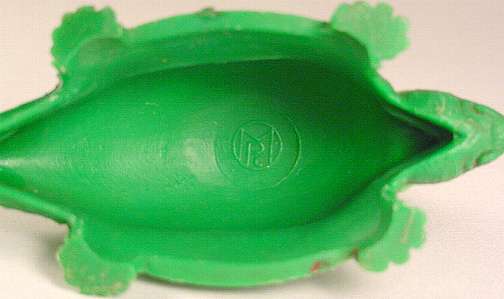
Markings - GLYPTODONT, 12' LONG (both on bottom of tail), MPC monogram |
| ... and that's it, no more MPC from me. |
|
UPDATE -
At one time MPC did put out some Dino playsets, so there must have been some MPC rocks and palm trees (much like the Marx ones, I imagine, but skimpier), and I believe there were some MPC cavemen too. |