Late Additions from Invicta Plastics
 • Lambeosaurus • Dimetrodon • Baryonyx • Troodon •
|
These figures were not included in sets sold in the US in the early 1990s, either because Invicta hadn't made them yet, or because copyright problems kept them out of the country (or so says rumor).
|
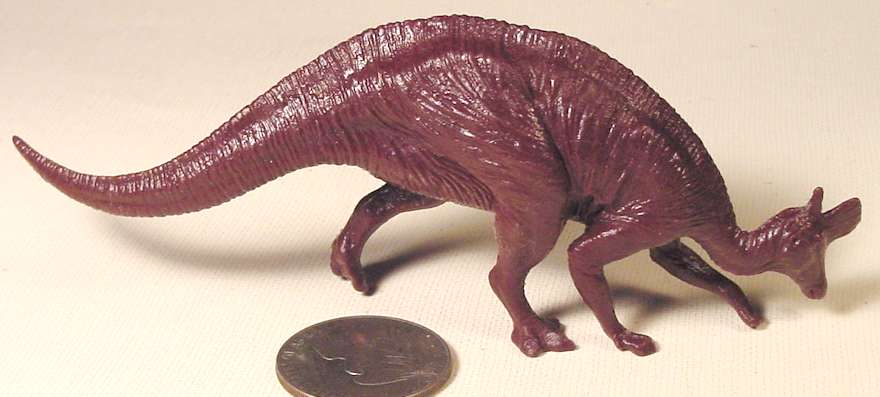
Lambeosaurus
The family Hadrosauridae comprise the duck-billed dinosaurs. All the duck-bills have very specialized dentition, and most have crests of one bizarre shape or another atop their heads. There are two subfamilies, the Hadrosaurinae and the Lambeosaurinae, both well represented by rubber dinos. The Hadrosaurinae may have solid bony crests, or may have none. The Lambeosaurinae have elaborate hollow crests. Corythosaurus (the Carnegie collection has one), Parasaurolophus (Marx made one, and Carnegie has one also) and Lambeosaurus (this one from Invicta) are all in the Lambeosaurinae. Lambeosaurus lambei Parks was described in 1923, and is reasonably well known from a half-dozen or so articulated skulls and postcranial skeletons, and some fragments of juveniles and other adults. Lambeosaurus magnicristatus Sternberg was described in 1935, but only two complete skulls, and one articulated postcranial skeleton, have been found. L. magnicristatus had a particularly formidable crest. Another species, Lambeosaurus laticaudus Morris, was described in 1981 from an isolated skull and skeletal fragments, and its assignment to the genus Lambeosaurus is uncertain. L. laticaudus was found in Baja California, Mexico; the others are from Alberta. All date from the Upper Cretaceous.
The text molded into the body of the Invicta figure is on the ventral surface ('way down between the legs), a difficult spot in a 2-segment mold, and it's not entirely legible. However I can make out the claim that Lambeosaurus was 15 meters long. The type species, L. lambei, was more likely 9 meters (29 feet) long. The problematic species from Baja may have been a hadrosaur giant, at something between 14 and 16.5 meters (45 and 54 feet) long.
Some skin impressions of various Lambeosaurus species have been found. Some show uniform polygon patterns, others show bony bumps scattered among large hexagons. Invicta modeled their figure with generic wrinkly skin.
|
Markings -
LAMBEOSAURUS
Length about 15metres
© THE NATURAL HISTORY MUSEUM LONDON
INVICTA PLASTICS LTD.LEICESTER ENGLAND
|

|
Dimetrodon
The synapsid reptiles weren't dinosaurs. However, dinosaur or not, no rubber-dino set feels complete without a Dimetrodon.
This is a pretty decent Dimetrodon from a two-segment mold, and right on the nose, scale-wise. Most depictions of Dimetrodon show him dragging along the ground, iguana-fashion. The Invicta version holds himself and his tail up off the ground a bit. I don't know if there's any technical justification for that pose. The Invicta neck might be a tad too long, too. More information about just where this Permian synapsid fits into the scheme of things is here.
|
Markings -
DIMETRODON
Length about 3.5metres
© THE NATURAL HISTORY MUSEUM LONDON 1993
INVICTA PLASTICS LTD.LEICESTER ENGLAND
|

|
Baryonyx
There is only one known species of this Lower Cretaceous carnivore, B. walkeri. He was found in England and described in 1986 from a single partial skull and some postcranial bits. His unusual features are a long, narrow snout with an excessive number of teeth, and a large claw (hence the generic name Baryonyx, "heavy claw"). Exactly where the claw attached is unclear. The snout and teeth have led to speculation that Baryonyx ate fish (apparently some piscine remains were found at the same site, as well). And sure enough, Invicta has modeled Baryonyx with a fish - the only one in the Invicta set to be sculpted with his prey. Invicta also put the claw on the forefoot, a not-unreasonable choice. The low crest on top of the snout seems to be correct, as least so far as the fossil remains indicate. The figure was made in a two-segment mold, and looks pretty good. Invicta seems able to make decently dynamic-looking figures from relatively simple molds. I actually like that aggressive green, too.
The length of Baryonyx has been variously estimated at anything from 6 to 10 meters (20 to 32 feet). That alone should give us a hint as to just how fragmentary the specimen is. Invicta went with 10 meters, which at 1:45 scale would be 8.7" (22 cm). So at something over 9 inches long, this figure is a bit oversized. The fish is 1.5 inches long, which scales up to 5.6 feet (1.7 m) - a pretty big fish to be caught right near shore. The fish looks like a modern-type bony ray-finned fish. The modern fish, the Teleostei, appeared quite early in the fossil record, but they started off small and herring-like, and didn't radiate into anything approaching the huge number of types, large and small, that we know today, until the mid-Cretaceous. So perhaps the Invicta Baryonyx is a bit ahead of his time.
|
Markings -
BARYONYX
UP TO 10 METRES LONG
© BRITISH MUSEUM (NATURAL HISTORY) 1989
INVICTA PLASTICS LTD.LEICESTER ENGLAND
|


|
Troodon
Troodon was one of the first dinosaurs to be described (Troodon formosus Leidy, 1856). Unfortunately the only specimen Leidy had was a single tooth, and he identified it as coming from something like a lizard. Stenonychosaurus inequalis Sternberg was described in 1932. T. formosus and S. inequalis were put in the same family in 1948, along with Saurornithoides mongoliensis. In 1974, Saurornithoides and Stenonychus were separated from Troodon and put in a new family. In 1987, they all went back into the family Troodontidae, and Stenonychosaurus inequalis and a couple of others - Pectinodon bakkeri Carpenter (1982) and Polydontosaurus grandis Gilmore (1932) - were determined to be junior synonyms for Troodon formosus (so the name Stenonychosaurus is obsolete, although it still appears in relatively recent texts).
The current lineup of the Troodontidae consists of three Mongolian genera and one North American genus, Troodon, of one species, Troodon formosus. Troodon is known from 20-odd fragmentary specimens and scattered teeth found in Cretaceous strata in Alberta, Montana, and Wyoming. Much of Troodon's skeleton remains unknown.
From what little fossil evidence has been found, it seems that Troodon formosus was a very light creature, weighing in at something like 50 kg, or 110 lbs. He had nice long predator-type jaws and distinctive teeth, and enough of his skull has been found to suggest that he had keen senses and, for a reptile, a very large brain.
The Invicta Troodon is another anomalous figure, the only one in the Invicta lineup with a separate attached base (the Blue Whale and the Ichthyosaurus came with clear stands but they don't attach; the figures just rest loose on top). The attachment pegs molded onto the bottoms of the feet are visible on the recumbent specimen. The text info is on the bottom of the base, rather than being molded onto the body of the figure. This is the only Invicta figure with a copyright holder other than the British Museum. Another peculiarity is that the base inscription is different on the two specimens I have - one is marked 2651A, and the other is marked 2651B. I have no idea what's up with that.
The overall sculpting of this figure I find bothersome. The molding is fine (from a 3-segment mold), but the figure looks basically like an ornithomimid with a slightly oversized head, and I suspect that the actual animal really looked more like a light-duty Deinonychus or Velociraptor (the ornithomimids or ornithomimosaurians are the "ostrich-mimic dinosaurs" such as Ornithomimus, Struthiomimus, and Gallimimus). The Invicta Troodon's head strikes me as being too wide, and the forelimbs a bit too wimpy. The figure's scale - a nominal 1:45 - is spectacularly wrong. Troodon formosus was about six feet long, snout to tail-tip, and he should therefore be much smaller than the Invicta Dimetrodon. This Troodon figure is closer to 1:10 scale than 1:45.
I don't believe this dino was ever sold in the US, and it is apparently now discontinued. UPDATE - oops! Not so - Troodon was sold in the US - alert reader Nathaniel corrects my error, and sends an interesting reminiscence of his adventures with this particular rubber dino -
Hi. I happened to stumble on to your site while searching Google for pictures of the dinosaur Troodon.
I notice that you say that you believed that the Invicta Troodon model was never sold in the US.
Well, I had one.
When I was younger my dad and I were visiting my grandparents in Connecticut. I got my Invicta Troodon during this trip. It was sometime in the early '90s; it was purchased for me by my grandmother during a trip to "Dinosaur Park" located in .... I believe Rocky Hill, Connecticut.
I was pretty ecstatic at the time about having a toy Troodon (this was, of course, in the days before raptors became "cool" so small meat eaters were very rarely found in model form). Being a kid I had no use for a stupid base on my new toy and upon returning back to my grandmother's house I promptly had my dad saw the pegs off with a serrated steak knife (I did this often with my models that had bases .... the loss of balance apparently was worth the gain in "playability" to me).
Sometime later I was given Gregory S. Paul's Predatory Dinosaurs of the World (I was about 12 by this time I think .... an advanced reader for my age) and after reading the book I realized that Troodon should have "sickle claws" on its inner toes. I noted with some dismay that my Troodon model was inaccurate, so I again consulted my father who took his heat gun and a nail and melted the dino model's inside toes until they resembled a lame facsimile of "sickle claws."
It was about this time I became a rotten little bastard of a kid who ruthlessly purged my "inaccurate" dinosaur models (vertically standing T-rexes and whatnot .... ); in other words I became almost obsessive-compulsive about accuracy. Predatory Dinosaurs of the World totally destroyed any childlike ability I once had to enjoy toy dinosaurs who were not up to the latest paleontological specs.
Later on I painted the Invicta Troodon a bizarre tropical green, black and red pattern with model paints. Then a while later, realizing how stupid my "parrot Troodon" looked, I painted it an olive, brown and black color scheme and noticed that my model Troodon's arms seemed to be much more diminutive then the Troodon in the book. So I melted (this time I did it myself) and pushed the "sickle claws" back down and started calling it a Compsognathus.
This is about as far as my memory of my Invicta Troodon goes, I have no clue where it is today. (Hopefully I didn't try to do field expedient update on it to conform to the theory that small theropods had feathers, all this of course, occurring back when feathered theropods were still Gregory Paul's far out theory and not a known fact like today. If I did try to give it feathers using a heat gun, perhaps I blocked out the traumatic memory of the resulting carnage, which is why I am now unsure of the model's fate.)
.... But I thought I'd verify that at least one example was sold in the US, anyway.
Well, I'll agree that it's easy to get carried away sometimes [Hey, you should know -- Ed.].
FURTHER UPDATE (April 2011) - Another alert reader, Matthew K., verifies the story -
I had most of the Invicta British Museum figures back in the early 1990's. I never got the mammals, and a few of them had not yet been issued yet. I was surprised to learn about the rarity of the Troodon figure because I had one. Bought at a toy store in Elmhurst, IL, USA around 1989 or 1990. The small store had just received a shipment of them. They had at least two of the Troodon figure for sale, at least I recall when I bought it, I did not get the only one there. So I can affirm it was sold in the USA. The toy store is long gone and I gave the figures to the biology classroom of the High School where I worked. Alas I suspect they are also long gone.
|
Markings -
INVICTA PLASTICS LTD
LEICESTER ENGLAND
2651A
STENONYCHOSAURUS (TROODON) 2m LONG
ARCHOSAUR REPRODUCTIONS LTD © 1987
BRITISH MUSEUM (NATURAL HISTORY) © 1988
|

|
|
To Realm of Rubber Dinosaurs
To Rubber Dino Figures from Invicta Plastics
To Site Index
EVERYTHING (TEXT, PHOTOS, CODING, LAYOUT, BANNER, ETC) ON THIS SITE COPYRIGHT © 2002 - 2006 BY
ME
|