
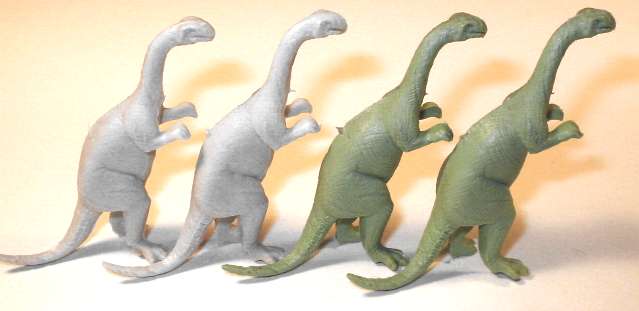
Marx produced two Plateosauruses. Both were part of the small mold group, and appeared about 1955. They were both produced up to about 1964, and reissued by Marx in the early 1970s. The two versions of Plateosaurus are almost identical. Both differences are visible on the RH side - 
At right, the G in LONG is a bit closer to the leg. At left, the 2 in 20 is not in line with the 0 and LONG. And that's it. Both figures lean slightly to their right - in fact, they lean to the right by the same amount. The lean is visible here (and I don't know if that's Plateosaurus (a) or Plateosaurus (b) in the photo - it hardly seems to matter). So, where did this figure and pose come from? When in doubt, consider Rudolph Zallinger and The Age of Reptiles - 
Hmmmm ..... well, maybe. The markings on both Marx Plateosauruses are identical. Plateosaurus markings - PLATEOSAURUS (left side of tail), 20'LONG (right side of tail) Plateosaurus (specifically, Plateosaurus engelhardti Meyer) was identified in 1837. About a hundred skeletons have been found, ranging from fragmentary to complete, and maybe a dozen skulls are known. He was a native of the upper Triassic, which is very early for a dinosaur. Nevertheless he was a formidable beast, averaging some 6.5 meters (21 feet) in length, with some big specimens reaching 9 meters (29 feet). Early notions that Plateosaurus and his close relatives were prosauropods, or ancestors of the sauropods (Apatosaurus, Brachiosaurus, Camarasaurus, Diplodocus, Cetiosaurus, etc) which flowered during the Jurassic, are now in disfavor. Despite his age, Plateosaurus seems too specialized to be a direct ancestor of the sauropods. Despite years of study, the lifestyle of Plateosaurus remains problematical. The usual guess is that he was some sort of vegetarian, based on study of jaws and teeth, but it's not as obvious as it is for some other dinosaurs. And his gait is still conjectural. His forelimbs are not all that well adapted for walking on all fours, but his spinal column isn't all that well adapted for bipedalism. Arguments one way or the other tend to be based on size ratios of various bones, which is all very interesting but not terribly convincing. Zallinger had it both ways in Age of Reptiles - one up, one down. It's odd that Marx made their Plateosaurus so small - he's hardly bigger than the Marx Dimetrodon, even though the biggest Dimetrodon species didn't exceed ten feet in length. And the Marx head is entirely wrong. Plateosaurus had a tall but narrow skull, rather than the blunt lump Marx stuck him with. |