

Marx produced two Trachodons. Trachodon (a) was part of the medium mold group, and appeared about 1955. Trachodon (b) was part of the revised mold group, appearing about five years later. Both versions were produced up to about 1964, and were reissued by Marx in the early 1970s. Trachodons (a) and (b) are, at first glance, identical, but there are quite a few differences. The most obvious is the right forepaw. Trachodon (a)'s forepaw is bent downward, and (b)'s is raised. 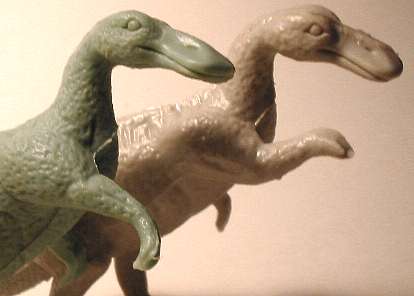
Trachodon (a) has a pronounced list to port (that is, to his left), but (b) stands much straighter. 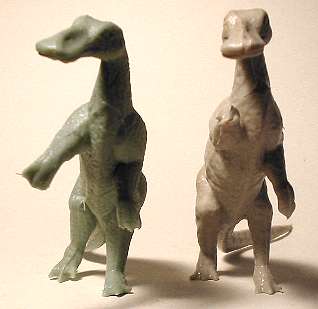
Both versions were made in 3-segment molds, but the mold separation line follows a different path - most obviously on the right side. Note also that the superficial lines on the hindlegs are substantially different, the hindlegs of (a) are heavier, and the right-side feet are different. 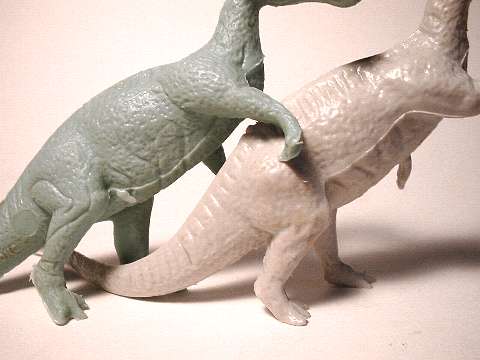
The tails and heads are set at different angles. 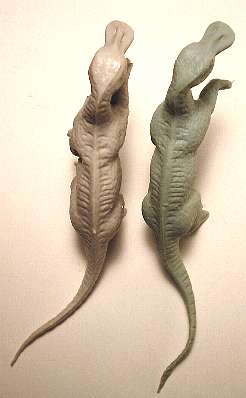
However, the markings on both are identical. Trachodon markings - TRACHODON (left side of tail), 30'LONG (right side of tail) The ELM version of Trachodon (a) is here, and a very nasty little copy distributed by Ja-Ru is here. At one time, Trachodon ("rough tooth") was paleontology's general-purpose duckbill. Zdenek Burian gave us a classic Trachodon vision in 1938 (with T. rex, and a gaggle of Struthiomimus in the background - click image for the full version). 
Trachodon relics were plentiful, or at least seemed to be. Outstanding specimens were on display. Two giants at the American Museum of Natural History, and a mummified skin, also at the AMNH, were identified as Trachodon remains. Then Trachodon disappeared. The AMNH specimens became Anatosaurus. Anatosaurus in turn disappeared, and became Edmontosaurus. What happened? First, a quick review of the relevant systematics. The hadrosaurs or duckbill dinosaurs are all in the family Hadrosauridae, set up by Cope in 1869. Subfamily Hadrosaurinae includes the flatheaded duckbills and the ones with solid crests. The subfamily Lambeosaurinae includes the ones with hollow crests. There is no reason to believe that this all won't change. Hadrosaur studies are complicated by the fact that many variants initially identified as differing genera and species are now thought to be due to developmental differences due to age or gender. In other words, the skeletons of the boys and the girls are different, and the juveniles lack some conspicuous features of the adults.The explanation has to do with teeth, and it's not all Trachodon's fault. Hadrosaur teeth are very distinctive. There were no frontal teeth, but the cheek dentition consisted of elaborate batteries of small teeth, each with several replacements. These teeth are so distinctive that some of the Big Names of 19th century paleontology - Leidy, Cope, Marsh - believed them to be diagnostic to the species level. Hence, they identified and named many species on the basis of very scanty finds, often single teeth. Better and more complete specimens discovered later sometimes revealed these identifications to be incorrect. Isolated teeth from the Upper Cretaceous of Montana were identified in 1856 as being from a new species, Trachodon mirabilis Leidy - OK so far. A later and more complete find had much the same teeth, and enough of a skull to identify it as a flat-headed duckbill. Later finds pinned down Trachodon anatomy rather well. But meanwhile, quite a number of other finds were assigned to the genus Trachodon, and too many of those assignments turned out to be incorrect. At least one ended up as a lambeosaur - that is, he had hollow crests on top of his head, and wasn't a flat-headed duckbill at all. And one tooth, once assigned to Trachodon, is now thought to belong to an ankylosaur. So maybe those teeth weren't diagnostic to the species level after all. But that left the genus Trachodon in a confused state. Apparently, the original description of Trachodon was just too general, allowing all sorts of riffraff in. So it was proposed in the early years of the 20th century to scrap the genus Trachodon altogether, and redistribute the various Trachodon species to better-defined taxa. So after the smoke cleared, the old Trachodon we thought we knew ended up as Edmontosaurus. This is not a very satisfactory result, as the name Trachodon dates from 1856 (T. mirabilis Leidy), but Edmontosaurus didn't put in an appearance until, I think, 1917 (E. regalis Lambe). So I should think that Edmontosaurus would be the junior synonym, and that Edmontosaurus finds would then be reassigned to the genus Trachodon. But that's not the way the pros did it. |